
GMG unveils G® Lubricant engine performance testing results: a transformative graphene energy saving solution
BRISBANE, QUEENSLAND, AUSTRALIA – Graphene Manufacturing Group Ltd. (TSX-V: GMG) (OTCQX: GMGMF) (“GMG” or the “Company”) is pleased to announce the results of the multi-year performance testing of G® Lubricant, a transformative graphene liquid concentrate additive designed to enhance the performance of diesel and gasoline (petrol) engines. This product has the potential to reshape the future of the global liquid fuels industry and offers an innovative solution that optimizes efficiency and power for stationary or mobile engines.
Unleashing the power of graphene
Up to 8.4% fuel efficiency improvement in a diesel engine
G® Lubricant, a graphene liquid concentrate that can be added to any mineral or synthetic oil used in an internal combustion engine, has been shown to increase fuel efficiency by up to 8.4% in a diesel engine. The amount of graphene in the final lubricant once G® Lubricant is mixed in is only ~ 1:10,000, with the balance of the concentrate consisting of lubricating base oil. As a result, G® Lubricant can be used safely in any internal combustion engine.
Over the past four years, GMG has conducted environmentally controlled testing of G® Lubricant in internal combustion engines monitored and verified by The University of Queensland. GMG’s test results have been corroborated by similar savings realized by customers over a number of years of field testing.
Figure 1 below shows the high level fuel efficiency improvement provided by the G® Lubricant additive.
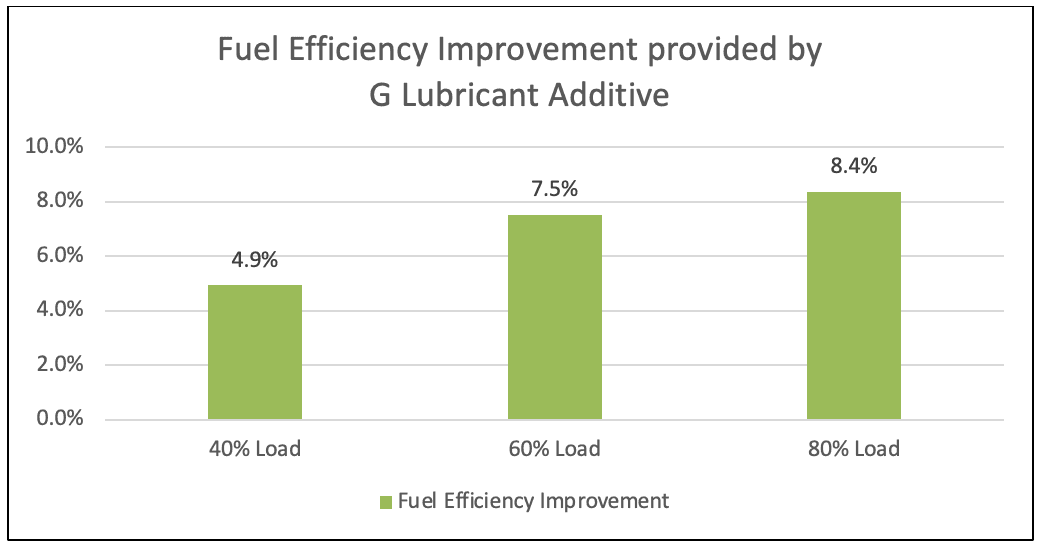
The data shows a clear increase in fuel efficiency performance from G® Lubricant when the load is increased on the engine. High loads for truck diesel engines are usually seen when the truck starts to move, and then at high speeds when encountering wind resistance. Usually stationary diesel engines for power generation operate at high load.
Test method
Detailed equipment and process for testing G® Lubricant
The following describes the equipment used and the process followed by the Company in demonstrating the fuel saving demonstration of the G® Lubricant in the diesel engine generator:
- A 30kVA (30 kW) Cummins diesel engine generator (with 14,784 hours of run time) as seen in Figure 6 and described in Figure 7 was purchased and set up in the GMG Richlands warehouse.
- The generator was connected to a 40 kW power load bank which consumed the energy produced by the generator and created the load, and a 500 litre self-contained fuel tank.
- Two calibrated flow sensors were connected (inflow and return/outflow) to the fuel lines and to a data logger which recorded the fuel consumption.
- An Energy Analyzer was used to log and track energy produced by the generator.
- Tests were conducted on loads of 40%, 60% and 80% of the 40 kW power load bank — 12, 18, 24 kW respectively.
- A baseline to record diesel fuel consumption under normal engine oil and operating conditions was completed with newly changed recommended premium diesel engine oil and a new oil filter. This oil change was carried out by a professional engine maintenance service company.
- The engine was run at the different loads (40%, 60% and 80%) and the baseline and G® Lubricant data set used for the analytics is when the maximum ambient temperature for the day was less than 33 degrees Celsius and relative humidity was between 50% and 80% with no rain. Fuel consumption for diesel engines changes when operating in rain or very high humidity or temperatures, so the fuel consumption data baseline and G® Lubricant engine oil additive performance testing were excluded for these times.
- Only steady state data was used and so any variance or anomalous data seen in either baseline or G® Lubricant datasets were removed from the analytics. Data sets were grouped into minute blocks.
- Once the baseline fuel tests were completed, the engine oil was drained and the oil filters were replaced. G® Lubricant with approximately 1:100 concentration was mixed at approximately 1% ratio by weight with a new batch of the same premium recommended engine oil and added to the generator engine. The end ratio of GMG’s Graphene to the diesel engine oil was approximately 1:10,000 by weight. The oil change was carried out by the same professional engine maintenance service company.

Figure 7: Diesel Engine Generator Equipment Parameters.
Engine — CUMMINS S3.8G7
- HP
- 37 approximately
- RPM
- 1500
- Cylinders
- 4
- Run hours shown
- 14,784
Alternator — STAMFORD UCI224F1
- kVA
- 33 standby rated (30 prime rated)
- kW
- 26 standby rated (24 prime rated)
- Power factor
- 0.8
- Other
- 240/415V at 50Hz, brushless
Comments
- Engine, alternator and radiator mounted on a substantial skid base.
- Installed in a weather protected, sound reduced canopy.
- Dimensions: 2520 × 1100 × 1650 mm (L × W × H); weight 1,460 kg.
- Residential grade engine muffler and flexible connection fitted.
- Single wall integral base fuel tank, approximately 100 litres.
- Battery pack heavy duty 12 Volt, with battery isolator.
- Engine driven battery charger.
- Cummins D521 generator control panel, with automatic & manual starting.
- Engine protection for high coolant temperature and low oil pressure.
- HMI with LCD panel, showing oil pressure, oil temperature, coolant temperature, battery charging Amps, Volts, Amps and Hz.
- Generator mounted 3 pole Schneider NS100N adjustable MCCB, & E/L shunt trip.
- Outlets: IP66, 1 × 32A 3Ph, 3 × 15A 1Ph, w/CB & RCD protection.
- Build date: 2004.
- Load test report; cleaned and painted; operating and maintenance manuals.
Figure 8: Detailed Diesel Engine Generator Performance Data.
| Load | Engine oil | Data points | Fuel used (L) | Avg power output (kWh) | Avg fuel efficiency (kWh/L) | Fuel efficiency increase |
|---|---|---|---|---|---|---|
| 40% | PDEO | 1,073 | 70.0 | 211.95 | 3.03 | — |
| 40% | PDEO + G® Lubricant | 1,367 | 66.7 | 211.84 | 3.18 | +4.9% |
| 60% | PDEO | 418 | 90.0 | 297.13 | 3.30 | — |
| 60% | PDEO + G® Lubricant | 1,486 | 84.9 | 301.31 | 3.55 | +7.5% |
| 80% | PDEO | 811 | 120.0 | 404.52 | 3.37 | — |
| 80% | PDEO + G® Lubricant | 1,756 | 110.6 | 404.21 | 3.65 | +8.4% |
Averages from steady-state, environmentally controlled testing (PDEO = premium diesel engine oil baseline). Standard deviation, minimum and maximum values are available on request.
How it works
Basis for the performance improvement
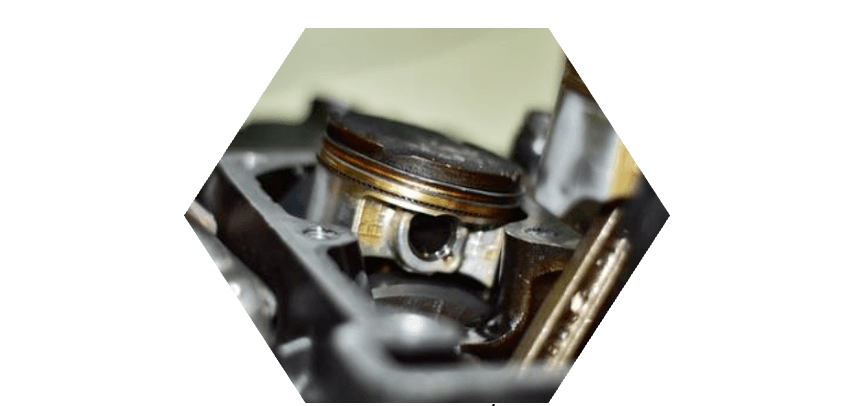
As seen in Figure 9, G® Lubricant by GMG improves fuel efficiency by creating less friction in the boundary layer lubrication of the pistons inside the cylinder block of the engine. It is widely accepted that approximately 30% of the fuel is used in an engine to overcome internal friction, and that approximately 60% of the engine friction is in the piston area. Graphene has also been seen to prevent wear and fill in wear scars of an engine, helping to improve piston sealing.
Patent
Patent progress of G® Lubricant
GMG submitted a patent application on the G® Lubricant product as soon as it was possible, and this is progressing through the usual process to be approved for the main target markets.
About GMG
Graphene Manufacturing Group
GMG is an Australian based clean-technology company which develops, makes and sells energy saving and energy storage solutions, enabled by graphene manufactured via an in-house production process. GMG uses its own proprietary production process to decompose natural gas (i.e. methane) into its natural elements — carbon (as graphene), hydrogen and some residual hydrocarbon gases. This process produces high quality, low cost, scalable, ‘tuneable’ and low/no contaminant graphene suitable for use in clean-technology and other applications.
The Company’s present focus is to de-risk and develop commercial scale-up capabilities, and secure market applications. In the energy savings segment, GMG has initially focused on graphene enhanced heating, ventilation and air conditioning (“HVAC-R”) coating (or energy-saving coating) which is now being marketed into other applications including electronic heat sinks, industrial process plants and data centres. Another product GMG has developed is the graphene lubricant additive focused on saving liquid fuels, initially for diesel engines.
In the energy storage segment, GMG and the University of Queensland are working collaboratively with financial support from the Australian Government to progress R&D and commercialization of graphene aluminium-ion batteries (“G+AI Batteries”). GMG has also developed a graphene additive slurry that is aimed to improve the performance of lithium-ion batteries.
GMG’s 4 critical business objectives are:
- Produce graphene and improve/scale cell production processes.
- Build revenue from energy savings products.
- Develop next-generation batteries.
- Develop supply chain, partners & project execution capability.
Explore the innovative world of graphene technology at graphenemg.com.
Documentation
Product documentation
The product brochure, Safety Data Sheet and customer success stories are available on request. Submit an enquiry and our South African team will send the documents relevant to your application.
FAQ
Frequently asked questions
How do I use G® Lubricant?
G® Lubricant is recommended to be added into new engine oil at a 1:100 ratio:
500 ml of G® Lubricant goes into 50 litres of engine oil; 50 ml of G® Lubricant goes into 5 litres of engine oil. This blended oil can then be added into your engine.
Is G® Lubricant recommended for all types of engines (diesel and gasoline/petrol)?
G® Lubricant is recommended for use in all combustion type engines where engine oil is used — whether diesel or gasoline/petrol engine.
Is G® Lubricant recommended for new engines?
Whilst G® Lubricant can be safely used in all engines including new ones, GMG suggests for G® Lubricant to be added into engines outside warranties for now.
Which type of oils is G® Lubricant recommended for use in?
G® Lubricant is suitable for use in (Group I, II, III, IV) mineral oils, semi-synthetic oils and fully synthetic oils — not suitable for Group V synthetic oils. Not to be used in engines with combined wet clutch or wet timing belt. Not recommended for use with other oil additive products.
Where can I get G® Lubricant in South Africa?
As the official African partner, we supply G® Lubricant locally. Submit an enquiry and our team will be in touch with pricing and availability.
How do I get more information?
Please contact us through the enquiry form and we’ll send detailed product information and documentation.
How has G® Lubricant fuel economy performance been proven?
All fuel economy test results have been verified by the University of Queensland for accuracy and repeatability: fuel savings test results up to 10%; coefficient of friction reduction up to 30%; wear-preventative test results up to 10%; and extreme-pressure test results reducing wear up to 20%.
Simera Trace is the official representative of Graphene Manufacturing Group in Africa and the Middle East. We are actively seeking sub distributors and market developers in these markets.
 www.simera-trace.com